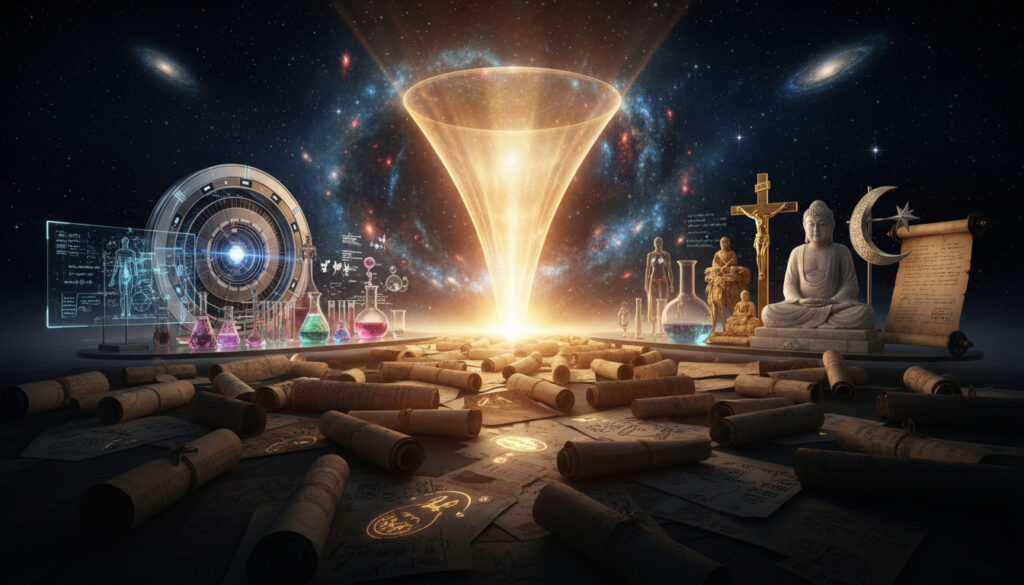
What Happens After Death – Science, Religion and Evidence
Scientific consensus holds that after death, brain activity ceases within minutes, leading to irreversible body decomposition. No empirical evidence currently proves the existence of an afterlife, a persistent soul, or consciousness surviving beyond clinical death. Yet alternative interpretations persist through rigorous documentation of near-death experiences and long-standing religious and philosophical frameworks that challenge purely materialist conclusions.
The question of what happens after we die sits at the intersection of neurology, physics, and theology. While biological processes follow observable patterns, the subjective nature of consciousness and the prevalence of transformative end-of-life experiences continue to fuel scientific investigation and debate.
This analysis examines the current scientific understanding of biological death, the evidence surrounding consciousness and near-death experiences, religious doctrines regarding the soul, and the philosophical divides that separate established fact from enduring mystery.
What Does Science Say Happens After Death?
From a biological standpoint, death initiates a cascade of cellular changes that are well-documented. When the heart stops, oxygen deprivation triggers neuronal depolarization, and brain function deteriorates rapidly. However, recent research has complicated earlier assumptions that the brain shuts down immediately.
|
Scientific / Materialist
Consciousness emerges from neural activity and ceases entirely when the brain dies; no mechanism exists for survival beyond biological death. |
Christian
The soul survives physical death and faces divine judgment, resulting in eternal residence in heaven or hell based on earthly actions and faith. |
Hindu
The soul (atman) undergoes reincarnation (samsara), transmigrating to new bodies based on the accumulation of karma until achieving moksha. |
Buddhist
Rebirth occurs without a permanent, eternal soul (anatta); consciousness streams transfer via karma until breaking the cycle of suffering. |
- Brain Surge Phenomenon: Neuroscientist Jimo Borjigin identified “hyper-activated” gamma waves in dying patients, suggesting a final burst of coordinated brain activity before flatlining.
- Oxygen Deprivation: Neuronal depolarization spreads rapidly without oxygen supply, creating irreversible conditions for consciousness within minutes of cardiac arrest.
- No Empirical Survival Evidence: The University of Virginia’s Division of Perceptual Studies (DOPS) has collected decades of testimonies but possesses no ordinary scientific evidence proving consciousness survives brain death, according to critic Kevin Nelson.
- Materialist Dominance: Mainstream neuroscience operates from an atheist/materialist framework where consciousness is strictly brain-emergent and ends at death.
- Decomposition Timeline: Cellular decomposition does not occur instantly; rigor mortis typically sets in within hours, followed by gradual tissue breakdown.
| Perspective | Core Claim | Evidence Level | Key Mechanism |
|---|---|---|---|
| Scientific / Materialist | Consciousness ends with brain death | High (biological) | Neuronal depolarization; gamma wave cessation |
| Christianity | Soul survives for heaven/hell judgment | Faith-based | Divine intervention; resurrection theology |
| Islam | Soul faces judgment; paradise or hell | Faith-based | Quranic revelation; divine decree |
| Hinduism | Reincarnation via atman and karma | Faith/Scriptural | Samsara cycle; karmic accumulation |
| Buddhism | Rebirth without eternal soul (anatta) | Faith/Philosophical | Consciousness stream; karma |
| Independent Consciousness | Brain filters universal consciousness | Anecdotal/Hypothesis | Filter model; quantum theories (unverified) |
What Happens to the Soul or Consciousness After Death?
The persistence of consciousness beyond clinical death remains one of neuroscience’s most contested questions. While materialist views hold that the brain produces consciousness, alternative hypotheses suggest the brain may merely filter or limit a universal consciousness that exists independently.
Near-Death Experiences and Brain Activity
Near-death experiences (NDEs) frequently involve vivid out-of-body perceptions, encounters with deceased relatives, hyper-real visions, and subsequent psychological transformations characterized by reduced fear of death and stronger interpersonal connections. These phenomena challenge strict biological models because they sometimes occur during periods of minimal or absent detectable brain activity.
Research in the 2020s, including work by neuroscientist Álex Gómez Marín following his own NDE, collaborates with hospitals to gather testimony and proposes that the brain functions as a “filter” for universal consciousness. This model attempts to explain why complex conscious experiences might occur when traditional neurological functions appear compromised. Studies highlight that while these experiences feel profoundly real to subjects, scientific verification of veridical out-of-body perception remains elusive.
Dr. Sam Parnia argues that consciousness interacts with the brain but is not necessarily produced by it, suggesting it might persist beyond current clinical death thresholds based on resuscitation data. However, researchers like Kevin Nelson maintain that NDEs can be attributed to identifiable brain processes such as REM intrusion or temporoparietal junction dysfunction, noting that extraordinary claims require extraordinary evidence currently absent from the literature.
Despite extensive data collection by UVA’s Division of Perceptual Studies across more than five decades, critics emphasize that there remains not “a shred of ordinary scientific evidence” demonstrating that consciousness survives the physical death of the brain.
Contemporary investigations by neuroscientists and institutions like UVA DOPS focus on identifying patterns in NDE testimonies rather than verifying metaphysical claims, seeking potential therapeutic benefits while acknowledging the absence of proof for post-mortem consciousness.
Philosophical and Evidential Debates
No peer-reviewed studies from the 2020s provide empirical proof of an afterlife, soul, reincarnation, or non-physical consciousness. Claims in these domains rely primarily on anecdotal reports and unverified hypotheses involving quantum mechanical processes that lack experimental validation. Philosopher John Gray notes that science maintains an empirical openness to “impossible” results, drawing parallels to historical investigations of phenomena once considered magical, yet this openness does not constitute acceptance of unproven assertions.
Recent critiques of models like NEPTUNE—which attempts to explain NDEs through temporoparietal junction activation or REM intrusion—highlight their failure to replicate the veridical details reported by experiencers or account for persistent perceptions when the eyes are closed.
Religious and Cultural Views on the Afterlife
Major world traditions offer structured narratives regarding non-physical continuity after death, providing frameworks that billions rely upon for existential meaning and moral guidance. These systems operate largely on faith and revelation rather than empirical demonstration.
Abrahamic Traditions
Christianity and Islam share foundational beliefs in the survival of the soul post-mortem, followed by divine judgment. Christianity emphasizes salvation through faith and resurrection, leading to eternal residence in heaven or separation in hell. Islam similarly posits a judgment day determining entrance to paradise (Jannah) or damnation (Jahannam) based on divine assessment of earthly life.
Eastern Philosophies
Hinduism teaches that the soul (atman) transmigrates through samsara, the cycle of rebirth, with one’s next incarnation determined by karmic accumulation. The ultimate goal remains moksha, liberation from this cycle. Buddhism offers a distinct interpretation through anatta (non-self), denying the existence of an eternal soul while affirming a stream of consciousness that continues through rebirth until reaching nirvana.
Large-scale analyses of end-of-life phenomena reveal consistent reports of visions involving specific deceased relatives, motifs that parallel narratives found across disparate religious traditions.
July 2025 Canada Child Benefit Bonus – Dates Amounts Key Facts offers insight into how societies structure support systems around life transitions, paralleling the cultural infrastructure built around death rituals across civilizations.
What Happens to the Body After Death?
The physical cessation of life initiates a predictable sequence of biological changes. Contrary to earlier assumptions of immediate shutdown, cells do not instantly decompose. Instead, the body undergoes distinct phases as metabolic processes halt and autolysis begins.
Immediate Biological Changes
Within minutes of cardiac arrest, blood circulation stops and oxygen deprivation triggers cascading failures. Pallor mortis causes paleness as blood drains from capillaries, while algor mortis initiates the cooling of the body toward ambient temperature. Meanwhile, recent findings indicate that certain brain regions may exhibit heightened gamma wave activity briefly following clinical death, challenging assumptions about instantaneous neuronal silence.
Decomposition Processes
Rigor mortis typically sets in within two to six hours as muscle fibers lock in place, lasting approximately 24 to 48 hours before primary flaccidity returns. Bacterial activity within the gut begins breaking down tissues, leading to decomposition gases and discoloration. Over days and weeks, unless preservation methods like embalming are applied, the body progresses through advanced decay until only skeletal remains persist.
How Does the Body Change in the Minutes and Hours After Death?
-
Cardiac arrest initiates oxygen deprivation. Brain activity may surge briefly (gamma waves) before electrical flatline occurs. Pallor mortis begins as blood settles.
-
Rigor mortis develops as muscles stiffen due to calcium buildup. Body temperature drops significantly (algor mortis). Neuronal depolarization completes.
-
Primary flaccidity returns as rigor mortis subsides. Decomposition begins with bacterial gas production and tissue discoloration.
-
Advanced decomposition progresses. In the absence of preservation, soft tissues break down through autolysis and bacterial action.
-
Skeletalization begins. Biological material returns to the environment, completing the physical cycle of death.
What Is Proven Versus What Remains Unknown?
| Established Scientific Findings | Questions Without Empirical Resolution |
|---|---|
| Brain activity ceases within minutes of cardiac arrest, with gamma surges preceding final flatline | Whether consciousness requires brain activity or can exist independently |
| Neuronal depolarization spreads irreversibly without oxygen supply | The exact moment subjective consciousness ends relative to clinical markers |
| Body decomposition follows predictable biological timelines (rigor mortis, putrefaction) | Proof of an afterlife, soul, or reincarnation mechanisms |
| Near-death experiences correlate with specific neurophysiological patterns | Verification of veridical perceptions reported during out-of-body experiences |
| Atheist/materialist frameworks dominate current neuroscience theory | Meaning and ontological reality of end-of-life visions of deceased relatives |
How Do Atheist and Cultural Perspectives Shape Our Understanding of Death?
Atheist and secular materialist perspectives reject notions of supernatural survival, positing that human consciousness represents an emergent property of neural complexity that dissipates upon biological failure. This view dominates academic neuroscience and maintains that experiences interpreted as spiritual are reducible to electrochemical processes.
Culturally, the anticipation of death has driven the development of elaborate ritual systems, from Ancient Egyptian mummification to modern hospice care. These frameworks provide psychological comfort and social cohesion, allowing communities to process grief and maintain continuity. Researchers note that regardless of metaphysical truth claims, the study of death and dying yields tangible benefits in end-of-life care and trauma processing.
Fallout New Vegas Remastered – Status, Rumors & Expectations represents how modern culture processes themes of survival and existence through narrative, paralleling the historical function of religious myth in addressing mortality.
What Do Leading Researchers Say About Consciousness and Death?
“Consciousness interacts with but is not produced by the brain, persisting beyond clinical death thresholds based on resuscitation data.”
— Dr. Sam Parnia, Critical Care Physician and Resuscitation Researcher
“Science maintained a previous hopelessness regarding death, assuming ‘that’s it,’ but we seek empirical validation for the transformative benefits reported by NDE experiencers.”
— Álex Gómez Marín, Neuroscientist and NDE Researcher
“Science must maintain empirical openness to ‘impossible’ results, as historical investigation has often transformed magic into understood phenomena.”
— John Gray, Philosopher
What Can We Conclude About What Happens After Death?
The evidence confirms that biological death entails the cessation of brain activity and the beginning of cellular decomposition, with no scientific proof of consciousness survival, soul persistence, or metaphysical afterlife. Simultaneously, the subjective reality of near-death experiences—reported consistently across cultures and occasionally during flatline brain states—ensures that the question of what happens after death remains open to philosophical inquiry and spiritual belief, even as empirical science maintains its rigorous standards for verification. Individuals must navigate between the certainty of biological finality and the possibility that current instruments measure only a subset of reality.
Frequently Asked Questions
Is there life after death?
Current scientific consensus finds no empirical evidence proving life continues after death. Consciousness appears dependent on brain function, which ceases irreversibly. However, religious faiths and some NDE researchers propose alternative models of existence that remain unverified by standard scientific methods.
What does the Bible say happens after death?
Christian scripture teaches that the soul survives physical death and undergoes divine judgment. Individuals face eternal consequences based on faith and actions, resulting in residence in heaven or separation in hell according to traditional interpretation.
Is reincarnation real?
Reincarnation is a central tenet of Hinduism and certain Buddhist traditions, positing that consciousness or souls transmigrate to new bodies based on karma. While some researchers investigate potential indicators, no scientific proof validates reincarnation as a physical process.
What is the atheist view of what happens after death?
Atheist and materialist perspectives hold that consciousness ends permanently at death. The self emerges from brain chemistry; when neural activity stops, subjective experience ceases entirely, leaving only the physical body to decompose.
Is there scientific proof of an afterlife?
No peer-reviewed studies provide empirical proof of an afterlife, soul, or non-physical consciousness. Claims rely on anecdotal reports from near-death experiences and unverified hypotheses. The scientific community maintains that extraordinary claims require extraordinary evidence currently absent from the literature.
Does brain activity continue after the heart stops?
Research indicates that specific brain regions may exhibit heightened gamma wave activity briefly following cardiac arrest. However, this activity fades rapidly, and neuronal depolarization spreads without oxygen, leading to irreversible cessation of consciousness within minutes.
More related posts
 Claudia Jessie: Religion, Eye, Relationship & Current Projects
 Queen Latifah: Son, Father, Partner, Gender Questions Answered
 Gerry Dee: Real Name, Net Worth, Current Projects & Biography
 Spaghetti and Meatballs Recipe – Homemade from Scratch
 Words That Start With O: Lists for Kids, 5-Letter & More
 Houses for Sale in Sudbury: Compare All Three Markets
 Mona Lisa: Why Is She So Famous? Facts, History, and Mystery
 Yannick Bisson: Biography, Career & 2024 Updates
