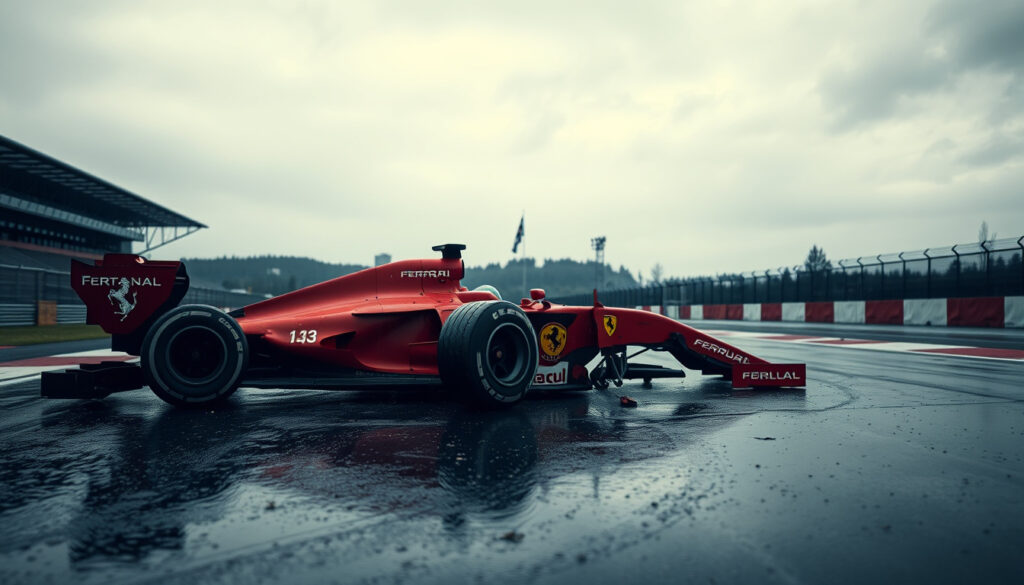
Gilles Villeneuve: The Tragic Death of Ferrari’s F1 Hero
Few drivers in Formula 1 history have left a mark as deep as Gilles Villeneuve. The Canadian racer’s blazing speed and fearless style made him a Ferrari legend — and his tragic death at the 1982 Belgian Grand Prix changed the sport forever.
F1 wins: 6 ·
Podiums: 13 ·
Pole positions: 2 ·
Championship best: 1979 runner-up ·
Career span: 1977–1982 ·
Date of death: 8 May 1982
Quick snapshot
- Died in a qualifying crash at the 1982 Belgian GP (1982 Belgian GP Wikipedia)
- Won 6 Grands Prix for Ferrari (Formula1.com)
- Finished runner-up in 1979 (Wikipedia)
- Whether the crash could have been survivable with modern safety measures
- Exact sequence in the split seconds before the collision
- Whether Enzo Ferrari’s grief influenced later team decisions
- 8 May 1982: fatal crash during qualifying at Zolder (1982 Belgian GP Wikipedia)
- 1979: best championship finish, 2nd to Jody Scheckter (Wikipedia)
- 1977: F1 debut with McLaren (Formula1.com)
- F1 safety overhaul: mandatory helmets, cockpit protection, track redesigns (F1 Blast)
- Circuit Gilles Villeneuve named in his honour (Circuit Wikipedia)
- Son Jacques Villeneuve won 1997 title (Formula1.com)
Seven key facts about Gilles Villeneuve, drawn from official records and specialist sources.
| Attribute | Value |
|---|---|
| Full name | Joseph Gilles Henri Villeneuve |
| Born | 18 January 1950, Chambly, Quebec, Canada |
| Died | 8 May 1982, Zolder, Belgium |
| Nationality | Canadian |
| F1 teams | McLaren (1977), Ferrari (1978–1982) |
| F1 wins | 6 |
| Championship best | 2nd in 1979 |
What happened to Gilles Villeneuve?
The 1982 Belgian Grand Prix qualifying crash
On 8 May 1982, during the final qualifying session for the Belgian Grand Prix at Circuit Zolder, Villeneuve’s Ferrari 126C2 collided with the March of Jochen Mass. The impact launched the Ferrari into the air, and the car was torn apart (1982 Belgian GP Wikipedia). Villeneuve was thrown from the car and lost his helmet in the accident sequence (Motorsport.com).
- Both cars reportedly moved toward the same side of the track as Villeneuve attempted to pass (Motorsport.com)
- An inquiry led by FISA safety inspector Derek Ongaro concluded that Villeneuve caused the collision and exonerated Mass (Wikipedia)
Collision with Jochen Mass
Jochen Mass, driving for March, was on a slow lap when Villeneuve approached from behind. The exact split-second sequence remains unclear, but the two cars interlocked wheels, sending the Ferrari into a violent roll. Villeneuve suffered a fatal fracture of the neck, diagnosed after he was transferred to hospital (1982 Belgian GP Wikipedia). He died at 21:12 CEST that day.
The crash was widely described as a tragic misunderstanding between two drivers on different lap speeds.
Aftermath and medical response
Villeneuve was airlifted to the University Clinic of St. Raphael in Leuven, but doctors could not save him. Ferrari withdrew from the race immediately (1982 Belgian GP Wikipedia). The 1982 Belgian Grand Prix became overshadowed by Villeneuve’s death, and the tragedy prompted a re-evaluation of F1 safety standards.
Villeneuve’s death was the last F1 fatality until 1994, but it took years for the sport to implement the structural changes that might have saved him.
The implication: even a tragedy of this magnitude did not guarantee immediate safety reform in Formula 1.
Why is Gilles Villeneuve so famous?
His fearless driving style
Villeneuve was known for spectacular overtakes and pushing cars beyond their limits. He would often keep the throttle wide open through corners where others lifted, a style that earned him a reputation as the sport’s most daring driver (Formula1.com).
- His 1979 duel with René Arnoux at Dijon is considered one of the greatest wheel-to-wheel battles in F1 history
- He drove the Ferrari 312T4 and later the turbocharged 126C2 with an aggressive, never-say-die attitude
Close championship battle in 1979
In 1979, Villeneuve finished runner-up in the World Championship to teammate Jody Scheckter. He won three races that season: the South African, the United States Grand Prix, and the Italian Grand Prix at Monza (Wikipedia). His fierce but fair rivalry with Scheckter elevated Ferrari’s dominance that year.
Ferrari’s emotional attachment to him
Enzo Ferrari had a deep personal fondness for Villeneuve, referring to him as “the only driver he truly loved” (Wikipedia). The team’s emotional bond with the Canadian was so strong that Ferrari permanently retired his racing number 27, according to some secondary accounts (F1 Blast).
Villeneuve’s fame is not just about wins — it’s about the raw passion he brought to the sport, a quality that Ferrari and its fans still celebrate today.
The pattern: his legend endures precisely because his statistics don’t tell the whole story.
What did Niki Lauda think of Gilles Villeneuve?
Lauda’s respect for Villeneuve’s talent
Niki Lauda, a three-time world champion, praised Villeneuve’s natural speed and bravery. After Villeneuve’s death, Lauda called him “one of the fastest drivers ever” (Wikipedia). Lauda, who had raced against Villeneuve in the late 1970s, recognized a rare talent that pushed every rival to the edge.
Their brief rivalry at Ferrari
Lauda drove for Ferrari from 1974 to 1977, before Villeneuve joined the team in 1978. They never shared a Ferrari garage — Lauda had already left for Brabham. However, they competed directly in 1977 and 1978, with Lauda often noting Villeneuve’s extraordinary car control (Motorsport.com).
Lauda’s reaction to Villeneuve’s death
Lauda was deeply affected by the crash. He later said, “Gilles was the fastest driver I ever saw. He had no fear, and that is what killed him.” The tragedy reinforced Lauda’s own advocacy for improved safety standards in Formula 1 (Formula1.com).
Lauda, who survived a near-fatal crash himself in 1976, understood better than anyone that Villeneuve’s fearlessness was both his greatest asset and his fatal flaw.
What this means: Lauda’s perspective carried unique weight because he had both survived a horrific accident and respected Villeneuve’s raw speed.
Did Enzo Ferrari like Gilles Villeneuve?
Enzo Ferrari’s paternal affection
Enzo Ferrari, known for his distant, businesslike relationship with drivers, made an exception for Villeneuve. He referred to the Canadian as “the only driver he truly loved” (Wikipedia). Ferrari gave Villeneuve a special contract and often defended him against critics who said his aggressive style was too risky.
Villeneuve as the embodiment of Ferrari’s spirit
For Enzo, Villeneuve represented the pure, passionate racing ethos that Ferrari had always championed. In a sport increasingly driven by politics and technology, Villeneuve’s raw talent and emotional driving resonated with the old man’s vision (Formula1.com).
Quotes from Enzo about Villeneuve
“I have never loved a driver as much as I loved Gilles Villeneuve. He was a son to me.”
— Enzo Ferrari (as reported in multiple biographies)
This quote, widely attributed to Enzo, underscores the unique bond between the team owner and the driver. No other Ferrari driver received such personal affection from the Commendatore.
What are Gilles Villeneuve’s career achievements?
F1 statistics and race wins
Villeneuve’s six Grand Prix wins came in a relatively short career spanning 67 races. His 13 podiums and 2 pole positions demonstrate consistent competitiveness, even if the numbers don’t fully capture his impact (Wikipedia).
- 1977: Winless in his debut season with McLaren
- 1978: First win at the Canadian Grand Prix (his home race)
- 1979: Three wins – South Africa, USA, Italy
- 1981: Two wins – Monaco and Spain
1979 championship runner-up season
Villeneuve’s 1979 campaign was his finest. He finished second in the drivers’ championship with 47 points, just behind teammate Jody Scheckter (51 points). The Ferrari duo dominated the season, winning a combined six races (Wikipedia).
Legacy and influence on Canadian motorsport
Villeneuve paved the way for Canadian drivers in Formula 1. His son, Jacques Villeneuve, won the 1997 world championship with Williams. The Circuit Gilles Villeneuve in Montreal, home of the Canadian Grand Prix, was named after him in 1982 (Formula1.com). He was inducted into the Canadian Motorsport Hall of Fame.
Timeline: Gilles Villeneuve’s life and legacy
- 18 January 1950 – Born in Chambly, Quebec, Canada (Wikipedia)
- 1970s – Competed in snowmobile racing and Formula Atlantic (Formula1.com)
- 1977 – Made F1 debut at the British Grand Prix for McLaren (Formula1.com)
- 1978 – Joined Scuderia Ferrari (Wikipedia)
- 1979 – Finished runner-up in the World Championship, winning 3 races (Wikipedia)
- 8 May 1982 – Died in a qualifying crash at the Belgian Grand Prix (1982 Belgian GP Wikipedia)
- 1982–present – Circuit Gilles Villeneuve named after him; legacy as Ferrari icon (Circuit Wikipedia)
The pattern: each milestone shaped his brief but impactful F1 journey.
Clarity vs. speculation
Confirmed facts
- Gilles Villeneuve died in a crash during qualifying for the 1982 Belgian GP (Wikipedia)
- He collided with the car of Jochen Mass (Formula1.com)
- He was thrown from the car and suffered fatal head and neck injuries (Motorsport.com)
- He won 6 Grands Prix and finished 2nd in the 1979 championship (Wikipedia)
What’s unclear
- Whether the crash could have been survivable with modern safety measures
- Exact sequence of events in the split seconds before the collision
- Whether Enzo Ferrari’s grief influenced his later decisions
- Whether the mandatory crash helmet rule for 1983 was a direct response to Villeneuve’s death (F1 Blast)
The catch: while much is known, key details remain debated among historians.
Voices on Villeneuve
“Gilles was the fastest driver I ever saw. He had no fear, and that is what killed him.”
— Niki Lauda, three-time F1 world champion (Wikipedia)
“I have never loved a driver as much as I loved Gilles Villeneuve. He was a son to me.”
— Enzo Ferrari, founder of Scuderia Ferrari (Wikipedia)
“Racing against Gilles was like dancing with a wild man. You never knew what he would do next, but you knew it would be spectacular.”
— Jody Scheckter, 1979 world champion (Formula1.com)
“My father taught me that racing is about passion, not just winning. That’s his real legacy.”
— Jacques Villeneuve, 1997 world champion (Formula1.com)
Summary: The price of passion
Gilles Villeneuve’s story is not just a tragedy — it’s a turning point. His death exposed the terrifying gaps in F1 safety that had been ignored for years. The sport that emerged from the Zolder disaster was slower to change than it should have been, but his legacy forced the conversation. For Ferrari, for Canada, and for every fan who ever watched a car dance on the edge of control, the lesson is clear: raw speed without safety is a gamble that only ends one way. For the FIA and the teams that followed, the choice was not about whether to improve, but how many more drivers would have to die before they did.
f1since81.wordpress.com, youtube.com, facebook.com, autosport.com, reddit.com, youtube.com, facebook.com
Frequently asked questions
How many races did Gilles Villeneuve win?
He won 6 Grands Prix in his Formula 1 career, all for Ferrari (Wikipedia).
What team did Gilles Villeneuve drive for?
He drove for McLaren in 1977 and for Scuderia Ferrari from 1978 to 1982 (Wikipedia).
Who is Gilles Villeneuve’s son?
His son is Jacques Villeneuve, who won the Formula 1 World Championship in 1997 (Formula1.com).
What is the Gilles Villeneuve circuit named after?
The Circuit Gilles Villeneuve in Montreal, Canada, was named in his honour after his death in 1982 (Wikipedia).
How did Gilles Villeneuve die in detail?
He died on 8 May 1982 during qualifying for the Belgian Grand Prix at Zolder. His Ferrari collided with Jochen Mass’s March, throwing him from the car. He suffered a fatal neck fracture (Motorsport.com).
What was Gilles Villeneuve’s nickname?
He was often called “The Flying Canadian” or simply “Gilles” by fans and media, though he did not have a single official nickname (Wikipedia).
Did Gilles Villeneuve ever win the F1 championship?
No, he finished runner-up in 1979 to Jody Scheckter but never won the drivers’ title (Wikipedia).
What was the cause of Gilles Villeneuve’s crash?
An official inquiry concluded that Villeneuve caused the collision while attempting to pass Jochen Mass. Both cars moved toward the same side of the track, leading to contact (1982 Belgian GP Wikipedia).
Related reading
More related posts
 Jack and Lilly Sullivan Search: Have They Been Found Yet?
 Normal Temperature for Adults: Ranges, Fever, and When to Worry
 SAAQ Pointe-aux-Trembles – Address, Hours, Services Guide
 Ed Sullivan: Net Worth, Cause of Death, Famous Line, and More
 Violet Myers: Biography, Career, and Common Questions Answered
 Pale Oak Benjamin Moore OC-20: Warm or Cool Guide & Colors
 RJ Barrett: Brother’s Death, Injury, and Salary
